More than 40 years have passed since Britain fought a secret war in Oman. Former Major Nicholas Ofield has returned for the first time since the conflict to retread his battlegrounds with his son, filmmaker Tristan Ofield. This blog contains excerpts from the production diary Tristan kept during filming.


Monday, 18 March 2013

Crossing the Wadi Darbat - ‘Operation Cyclops’ - March 1972


SAF Newsletter issue 9 of June 1972 reported,  Operation Cyclops was a remarkable result, both of the overall strategy of this war and the efficient tactics of one company of SAF soldiers.  In March 71 people said it would take a Brigade of infantry to clear the Wadi Darbat of enemy, and no one contemplated the idea.  In March 1972 3 Coy JR cleared it.   Large quantities of stores were found, including tea, rice, sugar, ghee, blocks of Russian TNT, detonators, fuse, 60mm mortar bombs, 2ins mortar bombs,  3.5” rockets, 7.62mm ammunition, a variety of ammunition including penicillin, blood plasma and curiously the tied-up body of a civillian who had been dead for a long time.  The Taqa to Darbat road was opened by JR’s Assault Pioneers and CSAF was able to walk along it in safety.”

In March last year I visited Dhofar for the first time in nearly forty years, and spent three weeks on the jebel, retracing those steps taken forty years ago. If my fading memory recollects…………………………

Operation Jaguar’ started at the beginning of October 1971, with the aim of clearing the adoo from the Eastern Jebel and opening it for development, By the middle of January 1972 the success of ‘Jaguar’ had effectively cleared the addo from the NE Jebel along the line White City (BATT/Firqa): JibJat (1 Coy JR - Maj Paul Wright) and Waterhole (2 Coy JR - Maj Mike Ball).  However, the adoo remained strong to the south of White City, and increasing numbers of SEPs reported large stores of weapons and ammunition within the caves of the Wadi Darbat. 

On 13th January 72, 2 Coy JR left the Waterhole and having walked over to JibJat was flown down to Salalah.  72 hours later they were flown back up to White City to take part in ‘Operation Amatol’,  to dominate the Wadi Khasayn to the south and Wadi Darbat to the east.  On the night of 20th Jan,  a combined force of BATT/Firqa and 2 Coy JR moved southwards from White City approx 7 klm  to the western side of the Wadi Darbat and established a base to NW of the village of Shuhait. The next morning as the mortars and other supplies were flown in there was strong adoo reaction from the south, where BATT/Firqa were positionned, and later mortar fire on to 2 Coy positions. 


Capt. Nick Ofield (L) and Capt Jim
Turner at the start of ‘Amatol’
Feb 1972


For the next month there was continuous activity in this region as ‘Amatol’ moved gradually southwards, and despite successes on the Khashayn, it was soon quite obvious that the adoo had no intention of abandoning the Darbat.  On one occasion, when the BATT attempted to go down into the Darbat, they were caught for over five hours in a running firefight, and Capt. Jim Turner took a platoon of 2 Coy to help extricate them.

On 26 Feb Mike Ball handed over 2 Coy JR to Nick Ofield and left for leave, but surprised everyone when he returned the next day to brief Nick on ‘Operation Cyclops’.  The outline plan was that 3 Coy JR under Maj Dick Fox, with Capt Jerry Blatch as 2i/c, would arrive and take over the existing BATT, Firqa and 2 Coy JR positions, and these forces would be released to move across the Darbat on the night of 01 March and establish a firm base on the Easten side, effectively completing the domination of the Darbat.


At that time there was a troop of BATT and about eighty Firqa involved in ‘Amatol’, but suddenly two thirds of the BATT were withdrawn, and only about twenty five of the Firqa were willing to make the move.  Nominally under overall command of BATT, with the reduction of forces involved, the commander was very happy to leave the detailed planning/coordination to the jaysh – he would control the BATT/Firqa element.  By that time 2 Coy JR had been working closely with BATT for several months and had established an excellent working relationship, so there was no difficulty with this ‘joint’ command. (In any event, we had no compatible radios which made communications extremely difficult other than by personal contact).

On the night 01 March, Nick Ofield and Jim Turner went on a recce with two of the Firqa and planned an outline route down into and across the wadi. 3 Coy JR arrived as planned to take over the position in the afternoon of 02 March, and in the evening the move itself took place.  The order of march was straight forward.  Nick Ofield with the two Firqa guides and a well armed section led the way, followed by two platoons of 2 Coy, heavily laden, then company HQ under Lt Karim Bux, BATT/Firqa, two more platoons of 2 Coy and a heavily armed rear section under Jim Turner.


They set off at 2100hrs, shortly after moon rise.  The going was slow and tiring, but the bright moon enabled everyone to see where they were treading, however, everyone felt very exposed and expected to be ambushed at any time.  They had originally hoped to make the move in file, to shorten the overall column length, but the dictates of the ground did not allow this.  In the event the column was over two hundred yards long.


Route across the Darbat 02-04 March 72

It is worth noting that 2 Coy had to carry all its heavy packs/clothing etc together with four days rations, whereas the Firqa carried only their weapons and small packs.  Consequently, having crossed the bottom of the Darbat and begun the ascent of the eastern side, the lightly armed Firqa came from behind and overtook 2 Coy, teasing them for being slow !!

Finally, at about 0130 on 03 March they reached the planned position on the eastern side, just south of the village of Qaathet.  The Firqa immediately moved off to the south east, and 2 Coy began to consolidate the position.  After ‘standing to’ at first light, they continued to build sangars and make breakfast.

Nick was invited over to OC BATT’s sangar for a cup of tea and a chat, and had just reached it when there was a shout of “incommers’”, and a line of six 82mm mortar bombs straddled the position.  Fortunately, no one was injured. However, when Nick returned to his own sangar he found that it had received a direct hit.  Had he not gone over to OC BATT for tea, then this is where he would have taken cover – with probable tragic consequences.


Direct hit on Nick’s sangar

Consequently, in view of the accuracy of the incoming fire and the generally exposed position, it was decided to move southwards approximately 6 klm and set up a new position by the Darbat Falls.  This move was completed during the afternoon, without any adoo interference.  The next day a further fifty Firqa crossed over the Darbat from the west in daylight, although they then later descended to Taqa leaving only half a dozen with BATT.


The new position proved to be a good one as it completely dominated the Darbat, and 2 Coy/BATT remained with this as their operating base until the end of March,   when 2 Coy moved to Mughsayl to take over from DR.  By this time 2 Coy had spent five months almost continuously on the jebel, and the move to the sea was looked on with great favour.
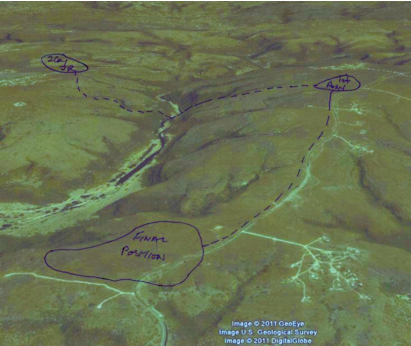


Route shown on 2007 Google Maps.
There were no villages or roads in 1972.


Written by Nicholas Ofield
Article courtesy of SAF Association.


Friday, 1 February 2013

KickStarter


I'll be honest with you - when I first got told about the concept of KickStarter by the lads at KRCS, I nearly cried with happiness. Always with their fingers at the extremes of what's happening in the digital world, they could not believe I hadn't heard of it before.

For those of you lagging a little behind KickStarter is a website that puts you in touch with people who want to fund your ideas. Yep you did read that right the first time! Designers, engineers, photographers, sculptors, game designers, filmmakers, musicians, inverters today is your day.

Now crowd sourcing (as its known as) has been around for a while but KickStarter has become the worlds foremost facilitator of pairing good ideas with the money to make them happen.

To date their successes include the spactualarlly ambitious Underwater Relm project captained by the talented and generous Eva Haslotin (releated completely by chance to someone in this documentary). 
Underwater Relm smashed expectations when they raise a wooping $150,000 a full $90,000 over their target.

Formers game designer ...... smashed records when they raised 1 million dollars in 24 hours.

Add this together with the numerous smaller projects asking for $500-$5000 and the benefits begin to make themselves apparent.

In fact KickStarter has proved to be so successful that major electronics firms have tried floating their ideas on the website to see if the public will actually pay for their research! Well you can't blame them for trying can you?

Okay why is this good for filmmakers? Trying to get traditional funding from a regional body was akin to trying to speak with your lips stapled to a wall. That was before the credit crunch. They have a limited budget and thus have to be choosy who they put money behind. I have been funded once by the regional system and I can't say its an experience I wish to repeat. 

This truly is the next step in the democratisation of filmmaking. We have the ideas. We have the gear. Now, with everybody's help we have the money. The most successful campaigns have had decent incentives to reward potential investors. In the case of a set of designer kitchen knives, a low level contribution of $1 would receive a hearty thanks, a $100 investment would see you with a set knives for yourself signed by the designer and engraved with your initials.

Film incentives range from getting a credit as a financier to getting weekly updates from the set, in depth tutorials on how effects were achieved, invitations to the premiere, personalised DVD copies. The list goes on.

KickStarter UK launched to a fanfare of relief from cash strapped artist who no longer have to sit on their ideas.

I have yet to take advantage of KickStarter. All my current projects were already open before I knew of KickStarter's existence. It is reassuring to know that if I came up with a phenomenal idea there's every chance I could follow through with it.... Providing other people agreed that is.

Take the time to peruse KickStarter yourself. You will be surprised what you will find. It could just blow your mind.

Tuesday, 14 August 2012

Anatomy of a Shot

I've been shooting a few extra cutaways to help chapter the various sections of the documentary.


The desert holds many secrets. Entire cities have been engulfed by sand. There are story's of brave crossings an survival. Moving dunes can snake through the desert almost alive.
Throughout the doc is a theme of discovery. For this shot I've decided to choose sun light, an AK47 round, and sand. The aim is to create a quick mysterious shot that will eventually become one of a series of shots.

Here is a quick run down of the kit I'm going to use


Dedo 300watt light with dimmer. This is a simple tungsten light whose brightness can be controlled from around 3000kelvin to 4200k. Gives off a nice warm light. The light can also be adjusted closer to the lens to control the spread of the light cast.


Two containers of beach sand gathered a few days ago while on assignment down in Bournemouth.


Two orange gels (half cto and full cto). To warm up the light in case the Dedo doesn't quite cut it.


Cheapo can of compressed air. Picked this up for about £2. Very handy for a quick blast to clean your lens or in this case to simulate a breeze.

Smoke machine. Gonna use this subtly to accent the breeze from the compressed air.

Painters tray this is where I'm going to create the scene. Using the time honoured principle that the audience never knows what is just outside the frame. In this case my desert will be less than half a meter, but the camera doesn't know that.


So here we are. Took about 30 mins.


The round positioned pointing slightly towards the lens give the shot a sense of perspective. Not sure if I'm too keen on the negative space on the right of the frame. Maybe could add some machine gun links or pieces of shrapnel trailing off into the distance. That might give the shot more depth and a sense of continuation - like the scene is bigger than it actually is. The light should extend all the way to the top of the frame. It looks quite moody, which is okay but I'd like to see it washed out. Some slow dolly movement would help keep the shot interesting for longer too. But for a first attempt it's not too bad.


Monday, 16 July 2012

That is a military map, it is unlikely to list interesting flora and fungi

I'll admit to being a little Balza about the danger of mines.... In fact the only thought going though my head while we were traipsing through the ground of Op Dragon was tr la la la la la la la it's hot

It only really dawned on me today when reviewing the interview I did with Mike Austin, that the danger became apparent.

Operation Dragon is a long story that I won't go into right now. Needless to say it all started with a landmine.

Okay it's been 40 years, the chances are everything that is going to explode would have done so by now. However that's kind of like thinking - that football pitch is 99% free of land mines, now go play.

The old man refused to go into the remains of any sangars because an old enemy trick was to mine sangars in case anyone went back into them. Was there a mine that had sat waiting 40 years for us? Luckily no.


It can't have escaped anybody's notice that blog post have been a little lacking recently. Well it's back on the doc all guns blazing now. With an aim to having a rough cut by January. Then I'm envisaging a KickStarter Campaign to buy permissions for news footage, music, some extra days shooting, as well as some After Effects work.